Dev Diary #1
March 31, 2026
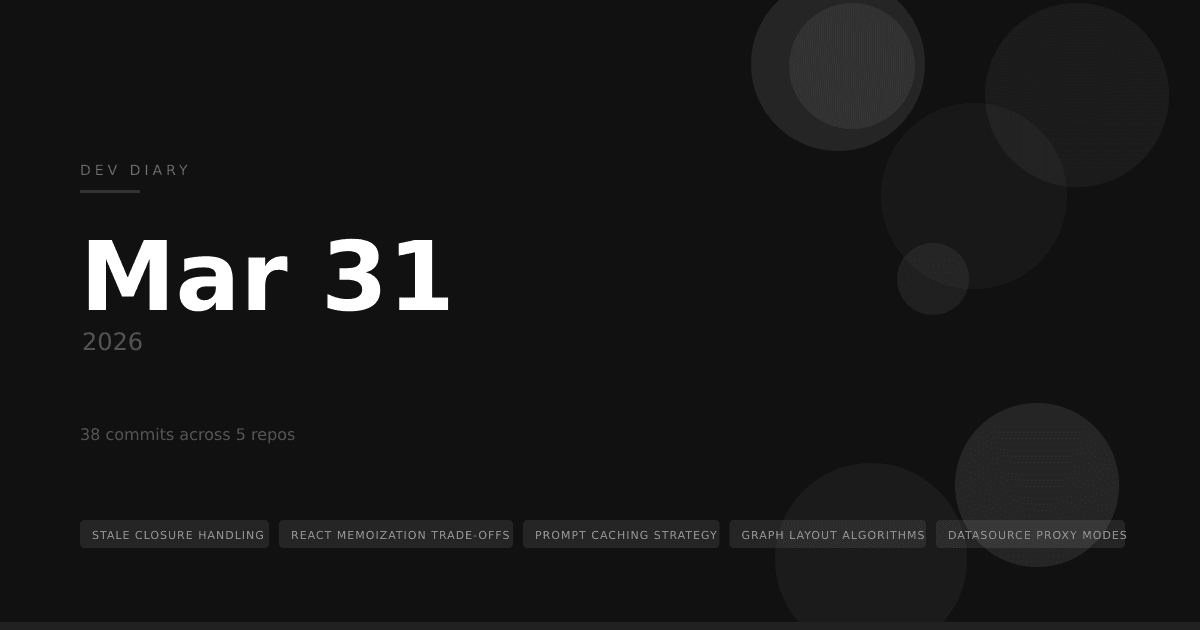
Developer Diary
Today was dense with UI refinement and observability infrastructure work — the kind of day where seemingly small interaction fixes compound into meaningful improvements across multiple surfaces.
I spent the morning wrestling with state synchronization challenges in a research visualization tool. The core problem: edits initiated through an AI-assisted interface weren't reflecting in the UI, even after successful API calls. I traced this through several layers — stale closure issues in React components, memoization preventing re-renders, and the subtle gotcha of reading state values synchronously after dispatching updates. The fix required removing memoization boundaries and forcing dynamic rendering, which feels inelegant but revealed deeper architectural constraints worth addressing later. The edit flow also needed defensive programming: detecting when proposed changes matched current state to avoid no-op mutations.
I then optimized the economic model of conversational features by switching to a more cost-efficient inference tier while implementing prompt caching. This required careful consideration of context windows and token budgets — ensuring truncation wouldn't degrade output quality while keeping API costs sustainable. The tradeoff between model capability and operational expense is always present.
On the canvas side, I integrated graph layout algorithms to automatically position nodes based on their connectivity topology. This required wiring up a third-party layout engine and reconciling its output with the existing persistence layer — ensuring auto-layout didn't discard user-intentional positioning.
The second half pivoted to observability infrastructure. I spun up a monitoring stack with several gateway layers, each requiring precise datasource configuration and health check endpoint exposition. The subtlety here was access mode semantics — whether services communicate directly or through reverse proxies affects latency and debugging complexity. I also added readiness probes to critical path services, following the principle that load balancers need signals beyond basic TCP connectivity.
Throughout, I refined interactions: double-click editing across card types, drag-and-drop reordering, improved text selection behavior during canvas manipulation. These feel peripheral but directly impact how developers experience the tool.